Best Social Media Website Examples (And Why They Convert)
We scored 13 social media homepages on 60+ conversion criteria. See which sections separate the top performers, and what your page is probably missing.
What high-performing social media website design gets right
Social media tool pages compete in a crowded category where switching costs are low and free tiers are everywhere. The strongest pages in this benchmark do four things early:
48.7/100
Avg. page score
Make the value outcome obvious in the first viewport so the buyer knows what workflow the product owns, scheduling, analytics, listening, or all-in-one management.
Layer risk reducers before the ask. Free trials, no-card messaging, cancel-anytime terms, and real product UI all reduce the perceived cost of trying.
Show the product as a real workflow. A publishing calendar, analytics dashboard, or inbox view, so the promise feels operational, not abstract.
Use action-oriented copy throughout. Verbs that name the outcome ("Schedule posts," "Track engagement," "Grow your audience") move visitors forward faster than passive descriptions.
6 best social media homepages analyzed in detail
Each company below is paired with its strongest section and scored across 60+ conversion criteria. See what they get right, and what you can borrow.
01
Comet Rocks, Social commerce and engagement tools in one platform.
5 years CRO + SEO at Qonto (2021–2025). After advising 15+ SaaS on their websites (Payfit, Pigment…), the same patterns kept breaking, so I decided to build the source of truth on what works on the web: the intelligence layer every tool, builder, and team uses to ship sites that perform.
“Comet Rocks builds a modular product narrative using feature tabs for micro-storefronts, conversational UI, and dynamic FAQs. The navbar (scored 100, top-scoring) anchors the experience with pricing in a dropdown and dual CTAs, so the visitor always has a clear next step regardless of where they are on the page.”
What makes this page stand out
"Micro-storefronts" concept creates a new product category — not landing pages, not full stores, but personalized shopping funnels
Price anchoring ($49/mo starting) in the hero removes a major objection early and signals accessibility
Brand logos (NARS, Supercilium, Qure) provide social proof from recognizable beauty/lifestyle brands
"From ad click to checkout" clearly maps the user journey, making the value proposition immediately tangible
Section we love
·Footer
1Links grouped into 4 labeled columns (Legal, Company, Resources, Connect) for easy scanning
2Newsletter signup with email field and Subscribe button captures non-buyers as secondary conversion
3GDPR compliance badge displayed near the bottom reinforces trust
4Imprint and Privacy policy links give clear legal transparency
02
Agorapulse, Social media management with measurable business outcomes.
5 years CRO + SEO at Qonto (2021–2025). After advising 15+ SaaS on their websites (Payfit, Pigment…), the same patterns kept breaking, so I decided to build the source of truth on what works on the web: the intelligence layer every tool, builder, and team uses to ship sites that perform.
“Agorapulse pairs an outcome-driven headline with a real testimonial and three icon-backed capability areas. The use cases section (scored 100, top-scoring) does the heavy lifting by connecting abstract "social media management" to concrete business outcomes, making the product feel like a solution rather than a feature set.”
What makes this page stand out
"L'outil français leader du marché" with 31,000+ daily users creates strong French market leadership positioning
Social Media ROI measurement feature is prominently positioned as a key differentiator — the ability to prove commercial value of social media efforts
Three-pillar value prop (content management, team collaboration, actionable insights) addresses the complete social media workflow
Competitive positioning against Hootsuite and Sprout Social with explicit 30% cost savings claim creates a clear switching narrative
Section we love
·Pricing TableBest in class
1Clean matrix with blue checkmarks and red Xs across 4 plans (Standard, Professional, Advanced, Custom) makes comparison effortless
2Collapsible categories (Overview, Publishing, Engagement, Reporting, Integrations and API, Support, Security) tame 30+ feature rows
3Info icons sit next to every feature name so users can clarify what each capability means without leaving the table
4Advanced column highlighted with a peach background and a filled orange Try now button steers users toward the recommended plan
5Try now and Get demo CTAs pinned in the header row above each column let users act the moment they spot the right plan
03
Emplifi, Social media platform for marketing, commerce, and customer care.
5 years CRO + SEO at Qonto (2021–2025). After advising 15+ SaaS on their websites (Payfit, Pigment…), the same patterns kept breaking, so I decided to build the source of truth on what works on the web: the intelligence layer every tool, builder, and team uses to ship sites that perform.
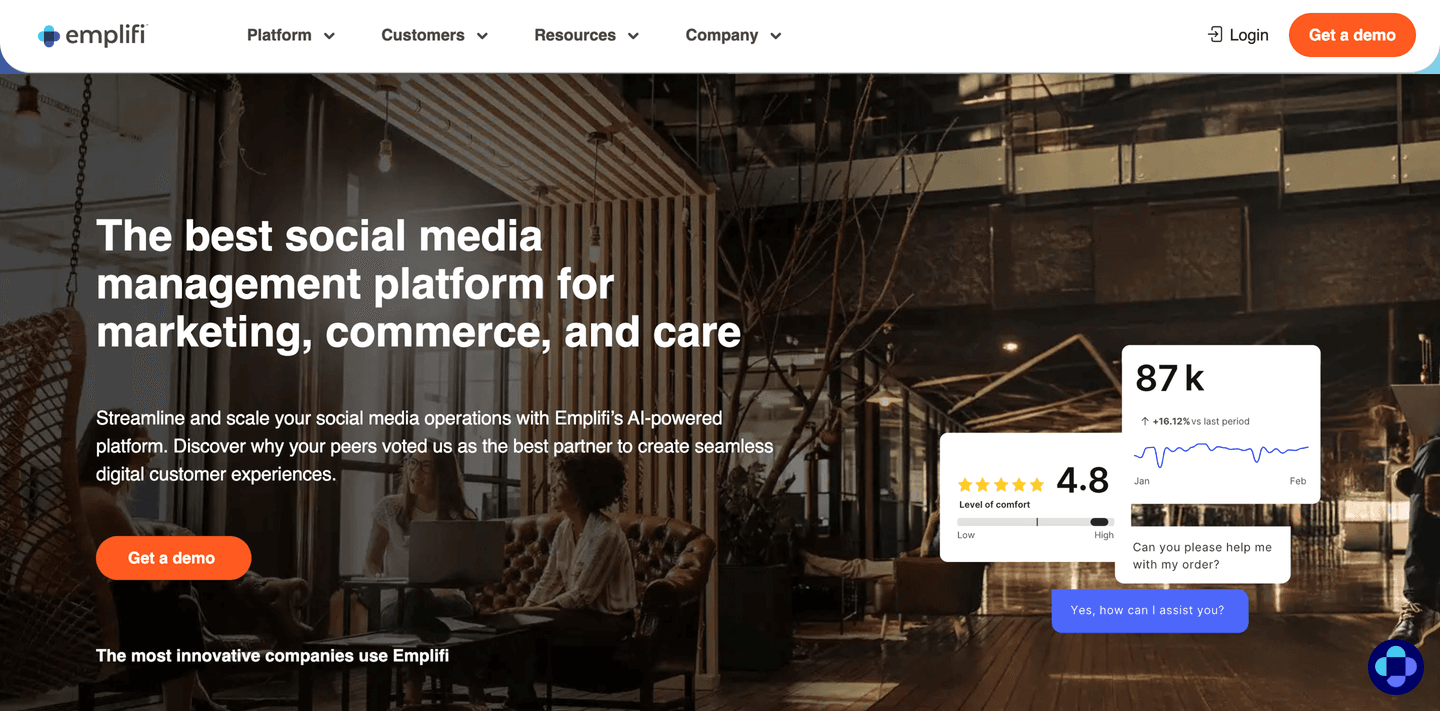
“Emplifi takes a bold positioning bet with a superlative claim backed by quantified UI overlays. The hero (scored 56) segments the audience into marketing, commerce, and care. A smart structural choice for a multi-product platform, though the execution could be tighter on specificity.”
Product UI screenshot showing a social media content calendar with scheduling capabilities gives prospects a concrete visual of the workflow.
Sub-copy mentioning "seamless digital customer experiences" and "Scale social marketing, commerce, and care from one unified platform" communicates platform breadth.
Single "Get a demo" CTA focuses the conversion path, appropriate for an enterprise-focused product.
Section we love
·Hero
1The best social media management platform is a bold superlative differentiation claim
2UI overlays (87k metric, 4.8 rating, chat window) prove the product handles analytics and customer care
3For marketing, commerce, and care defines three specific audience segments in the headline
4Orange Get a demo CTA on dark lifestyle background creates strong contrast and visibility
04
Breakcold
59/100
What makes this page stand out
The subhead positions “AI Native CRM for modern salespeople,” paired with five feature tabs like “Flexible Data” and “Meeting Recorder.”
The benefits section quantifies automation with “50+ data points” enrichment and multichannel follow-ups via Email, LinkedIn, WhatsApp, Telegram, Phone.
Customer proof includes a scrolling logo strip plus ratings: “114+ reviews on G2.com 4.8” and “91+ reviews on Capterra 4.9.”
The case studies use hard outcomes like “6 deals in 14 days ($14k),” “$60,000 in 3 months,” and “$23,000,000 ARR.”
Section we love
·Hero
1Outcome-led H1 (The CRM that kills admin work so you can sell more) names the category and the payoff in one line
2Audience and differentiation are explicit (AI Native CRM for modern salespeople, badge Easier Better and Cheaper CRM)
3Real CRM product UI (Companies table with Nike, Microsoft, deals and subscription columns) lets prospects picture their own pipeline
4Start Free Trial button doubles as risk reducer, backed by a partner logo wall (Hunter, Scalezia, EY, Favikon, Findymail) above the fold
05
Bulkmark
57/100
What makes this page stand out
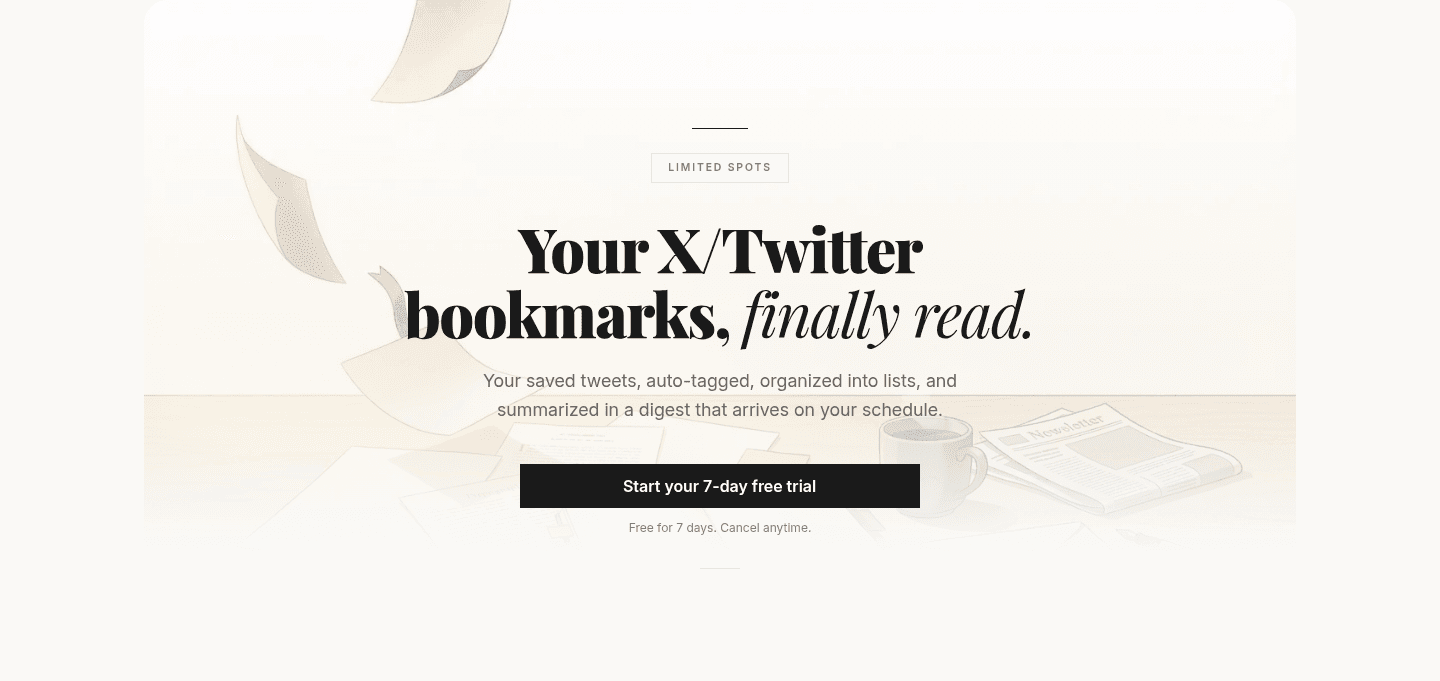
The above-fold urgency tag says “Limited spots,” reinforcing scarcity before any scrolling.
The problem section quantifies pain with “3,000+,” “97%,” and “12 sec” in bold metric-first tiles.
The product walkthrough uses “Demo · 60 sec” plus “No sound required. Captions inside.” to reduce viewing friction.
The pricing table highlights “$59/yr -40%” and “40 of 50 remaining,” plus “Your price stays the same.”
Section we love
·Cta
1Single black CTA Start your 7-day free trial dominates the empty composition with zero competing actions
2LIMITED SPOTS pill above the headline injects scarcity that pairs naturally with the timed trial
3Reassurance line Free for 7 days. Cancel anytime sits directly under the CTA to defuse trial commitment fear
4Editorial headline Your X/Twitter bookmarks, finally read. names the exact aha-moment the buyer wants
06
Sprout Social, Social media management built for data-driven teams.
5 years CRO + SEO at Qonto (2021–2025). After advising 15+ SaaS on their websites (Payfit, Pigment…), the same patterns kept breaking, so I decided to build the source of truth on what works on the web: the intelligence layer every tool, builder, and team uses to ship sites that perform.
“Enterprise-leaning structure that stays navigable for mid-market buyers. The hero (scored 78) combines G2 awards with real product UI showing sentiment analysis and AI Assist, creating a trust-plus-proof combination that justifies a premium positioning.”
What makes this page stand out
30-day free trial ("Essai gratuit de 30 jours") is significantly more generous than competitors' typical 14-day trials, demonstrating confidence in conversion.
Analytics dashboard and AI features visible in the hero demonstrate the depth of the platform beyond basic scheduling.
The enterprise positioning differentiates from consumer-grade tools like Buffer or Later.
Sprout Social's consistent emphasis on analytics and reporting signals its core strength as a measurement and insights platform.
Section we love
·Hero
1G2 #1 Best Overall Software 2024 badge with four additional category wins stacks powerful social proof
2Real product UI (sentiment dashboard at 82% Positive, trend charts, AI Assist panel) proves the tool works
3Dual CTAs (Start your free trial + Request a demo) with No credit card required removes all friction
4Product category (social media management) stated clearly in both headline and subtext
5#1 differentiation claim backed by G2 awards makes the competitive positioning concrete and credible
See how your page compares to the 55.6 average page score
Run a section-by-section diagnostic on your social media page and get prioritized fixes for clarity, trust, and product proof.
Design patterns we see across high-performing social media pages
Across 10 social media pages reviewed, the pages that convert tend to do one thing exceptionally well in the first screen: pair a specific workflow promise with visible product proof and an immediate low-friction path forward.
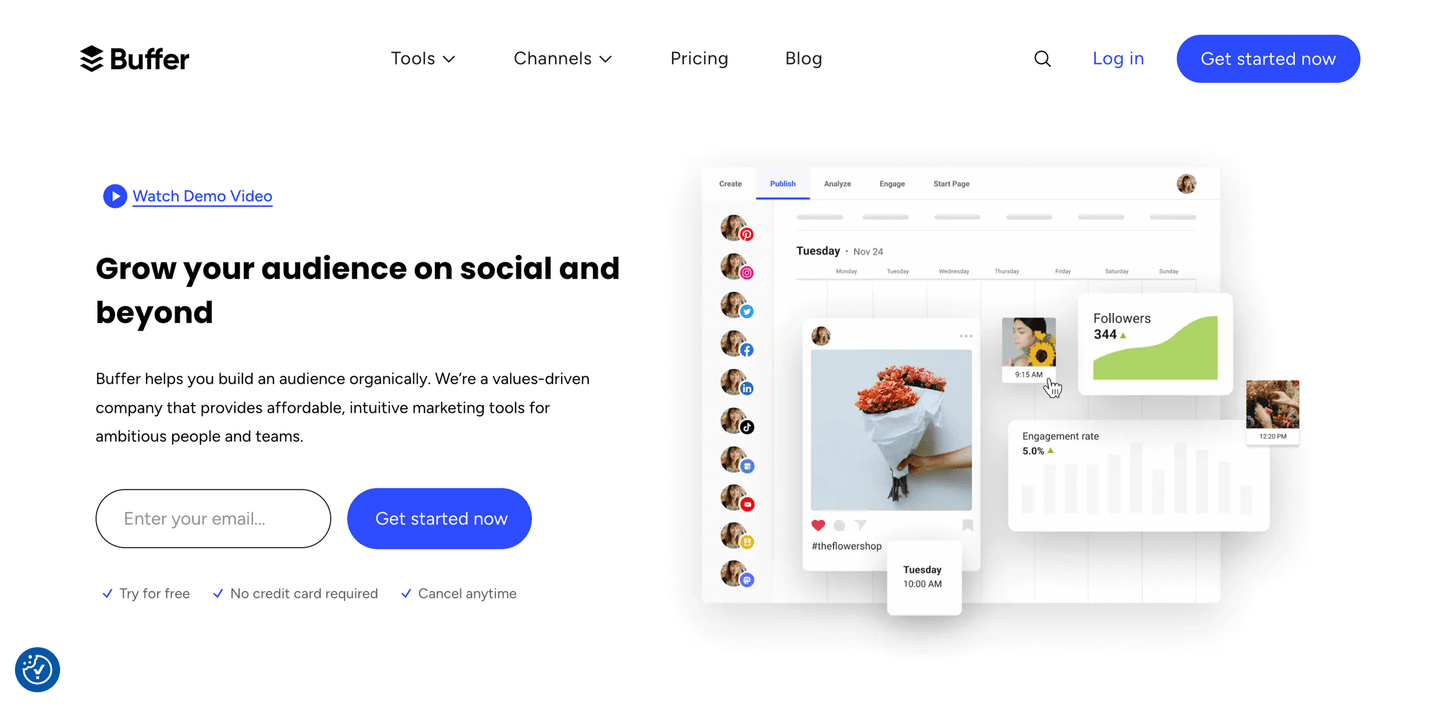
The strongest patterns combine action-oriented copy with real product interfaces (publishing calendars, analytics dashboards, scheduling views), so the visitor sees the tool in action before committing. Later's trust section (scored 100) stacks Nike and Unilever logos across two rows with 13+ brands, while Buffer's hero pairs triple risk reducers (free, no CC, cancel anytime) with a real publishing calendar showing 344 followers. Use website section examples to compare how these building blocks show up across page types.
1Sharp contrarian headline reframes the value: not more creators, the right ones
2Vetting mechanism spelled out: brand fit, safety, and past performance checked upfront
3Concrete promise that handpicked creators are proven to drive sales and brand lift
4Row of real creator profile cards visually shows what the right ones look like
Reviewed design-pattern pick from Later’s value proposition section.
What I love about this section
Sharp contrarian headline reframes the value: not more creators, the right ones
Vetting mechanism spelled out: brand fit, safety, and past performance checked upfront
Concrete promise that handpicked creators are proven to drive sales and brand lift
Row of real creator profile cards visually shows what the right ones look like
Overlooked sections that quietly drive clarity and conversions
In this set, navigation and utility sections often do more conversion work than teams expect. Iconosquare's navbar (scored 100) uses a Solutions dropdown organized by sector and channel, with a dedicated column listing every supported platform, turning the nav into a product discovery tool.
Comet Rocks' use cases section (scored 100) presents phone mockups with real social media interfaces against a dark background, creating a premium feel that supports product credibility. And Agorapulse's pricing table (scored 100) lists 30+ features across four plan columns with collapsible categories, giving comparison-shoppers exactly what they need without forcing a sales conversation.
1Recognizable logos (YouTube, LinkedIn, Slack, Zapier, Facebook, X, Instagram, Pinterest) confirm it fits the marketer stack
2Use case framing (No more switching tabs, centralize social media actions in one place) makes the value concrete
3Check out all our integrations CTA gives a clear path to the full integration list
4Hub-and-spoke visual puts the product at the center wired to every channel, signaling broad coverage
Reviewed overlooked-section pick from Iconosquare’s integrations section.
What I love about this section
Recognizable logos (YouTube, LinkedIn, Slack, Zapier, Facebook, X, Instagram, Pinterest) confirm it fits the marketer stack
Use case framing (No more switching tabs, centralize social media actions in one place) makes the value concrete
Check out all our integrations CTA gives a clear path to the full integration list
Hub-and-spoke visual puts the product at the center wired to every channel, signaling broad coverage
If you are refreshing a social media landing page, treat navigation, use cases, and pricing as conversion infrastructure. Not afterthoughts.
How does your social media homepage compare?
Five quick questions to see where your page stands against this social media benchmark. The checklist focuses on CTA, Hero, and Footer. The three section types that separate the strongest pages in this dataset. For a full section-by-section audit, try our landing page audit.
Interactive quiz
What would your social media homepage score?
Question 1 of 5
0%
Can a visitor identify what your social media tool does in under 5 seconds?
"Social media scheduling for agencies" beats "the all-in-one platform for modern teams."
Reviewed by
Gabriel Amzallag , Founder, Web Anatomy
5 years CRO + SEO at Qonto (2021–2025). After advising 15+ SaaS on their websites (Payfit, Pigment…), the same patterns kept breaking, so I decided to build the source of truth on what works on the web: the intelligence layer every tool, builder, and team uses to ship sites that perform.
Benchmark-backed answers for social media website design
FAQ: Best Social Media Websites (Benchmarks)
Quick answers to common questions about what makes the best social media websites convert, based on section-level benchmark data from this review.
What are the best social media management websites?
[01]
The strongest performers in this June 2026 benchmark are Comet Rocks, Agorapulse, Sprout Social, Iconosquare, Sendible, and Emplifi. Across 10 social media homepages scored against 60+ criteria, these pages convert by pairing action-oriented copy with visible product proof: Sprout Social stacks G2 "No.1 Best Overall Software 2024" awards with sentiment analysis UI, and Iconosquare maps an exact 28-day onboarding timeline with 90% automation and 12+ hours saved by Day 28.
What makes social media tool websites harder to convert than other SaaS pages?
[02]
Social media tools compete in a crowded category with low switching costs and widespread free tiers. Visitors arrive already comparison-shopping, so the page has to prove differentiation fast. Agorapulse pairs "Effective social media management with impactful business outcomes" with a named, photographed testimonial from Joanne West. Emplifi backs a bold "best social media management platform" claim with UI overlays showing 87k metrics and 4.8 ratings. Headlines without proof bounce fastest.
What is the biggest design mistake on social media marketing websites?
[03]
Leading with generic "all-in-one" positioning while delaying concrete product proof and risk reducers. The average page in this June 2026 benchmark scored 55.6. Top performers show what the tool feels like in the first viewport: Sendible stacks triple risk reducers (no card, cancel anytime, no contract) next to a real scheduling calendar, and Comet Rocks exposes Micro-storefronts and Dynamic FAQs in the nav so evaluators self-qualify before scrolling.
What sections should a social media website include?
[04]
A clear hero with action-oriented copy and dual CTAs, an early trust layer (client logos, G2 badges, testimonials), a product UI walkthrough or how-it-works section, feature areas tied to outcomes, and visible risk reducers like free trials or no-card messaging. Iconosquare's 28-day timeline and Sprout Social's award-plus-UI hero are strong templates. Sendible stacks triple risk reducers (no card, cancel anytime, no contract) next to a real scheduling calendar.
How many social media website examples should I review before redesigning?
[05]
Three to five is enough if you pick by theme and compare section by section. Only 17% of homepages in this benchmark score in the top tier, so the gap is concentrated in a few blocks. Study Comet Rocks for navbar-led positioning, Agorapulse for outcome headlines, Sprout Social for enterprise trust, Iconosquare for onboarding proof, and Sendible for risk reduction.
Where can I find great social media landing page examples?
Use a structured rubric that checks clarity, trust, and friction instead of relying on subjective feedback. Run your page through the landing page analysis for a section-by-section score.