Skip to content

Best InsurTech Website Examples (And Why They Convert)

We scored 8 insurtech homepages on 60+ conversion criteria. See which sections separate the top performers, and what your page is probably missing.

Updated June 20268 pages analyzed
#CompanyScore

Scored by AI across 60+ conversion criteria

Bestow landing page
#1
56/100
Scroll to explore
Analyze your insurance pageFree. Takes 2 minutes.

What the best insurance websites get right

Insurance buyers arrive skeptical, comparison-ready, and unlikely to share personal data until they feel safe. The strongest insurtech website design patterns in this benchmark do four things consistently:

47.7/100

Avg. page score

  • Build trust before the ask. Show regulatory badges, customer counts, or carrier logos so visitors feel safe before sharing personal data.
  • Make coverage simple. Break complex insurance products into plain language so a buyer understands what they get in under five seconds. Pair specific benefits with quantified proof.
  • Remove the biggest friction. Surface instant quotes, no-exam messaging, or cancel-anytime terms so the next step feels low-risk.
  • Anticipate cautious buyers. Design for people who comparison-shop and need reassurance at every scroll depth, not just in the hero.

8 best insurtech websites analyzed in detail

Each company below is paired with its strongest section and scored across 60+ conversion criteria. See what they get right, and what you can borrow for your own insurance homepage design.

01

Bestow

Editor's pick56/100

What makes this page stand out

  • The subheadline promises “modernize workflows, launch faster, and lower costs,” pairing three outcomes in one line.
  • The primary CTA is “Let’s chat,” linking to /contact and placed above the fold.
  • The trust strip states “Trusted by partners like” and shows five logos: Transamerica, USAA, Nationwide, Equitable, Sammons.
  • The platform section uses lifecycle tabs (Sales, Application, Underwriting, Bind, Policy Issue, Maintenance, Claim) and highlights “97%” self-service.

Section we love

·Resources
Bestow Resources section
  1. 1A large Featured story (TechCrunch: Bestow lands $120M Series D from Goldman Sachs) stands out above the smaller grid items
  2. 2Visit newsroom button plus clickable article cards push visitors into deeper company content
  3. 3News, leadership bylines, and partner stories stay tightly on-topic for the insurance audience
  4. 4Press coverage of a $120M raise signals momentum and positions Bestow as a credible market player
02

Alan, A prevention-first health model that blends insurance, care, and everyday wellness into one platform.

51/100
Gabriel AmzallagGabriel AmzallagFounder, Web Anatomy

Alan's homepage turns a prevention-first health insurance model into a concrete, measurable story. The value proposition section (scored 83) layers three quantified proof points (30%+ weekly active users, 260k medical chats, and 95% quality rating), so the promise of digital-first care feels verifiable, not aspirational. A 3D mascot and card-based layout make the product feel approachable without sacrificing credibility.

What makes this page stand out

  • 1 million members across France, Belgium, Spain, and Canada demonstrates significant international scale for a European health-tech company
  • Friendly purple bear mascot character with doctor outfit creates a distinctive, approachable brand identity that humanizes healthcare
  • Visual UI elements showing reimbursement notifications, breath exercises, and meditation demonstrate the product's daily wellness engagement
  • "Our unique model" CTA invites curiosity about the differentiated approach rather than pushing a generic signup

Section we love

·AboutBest in class
Alan About section
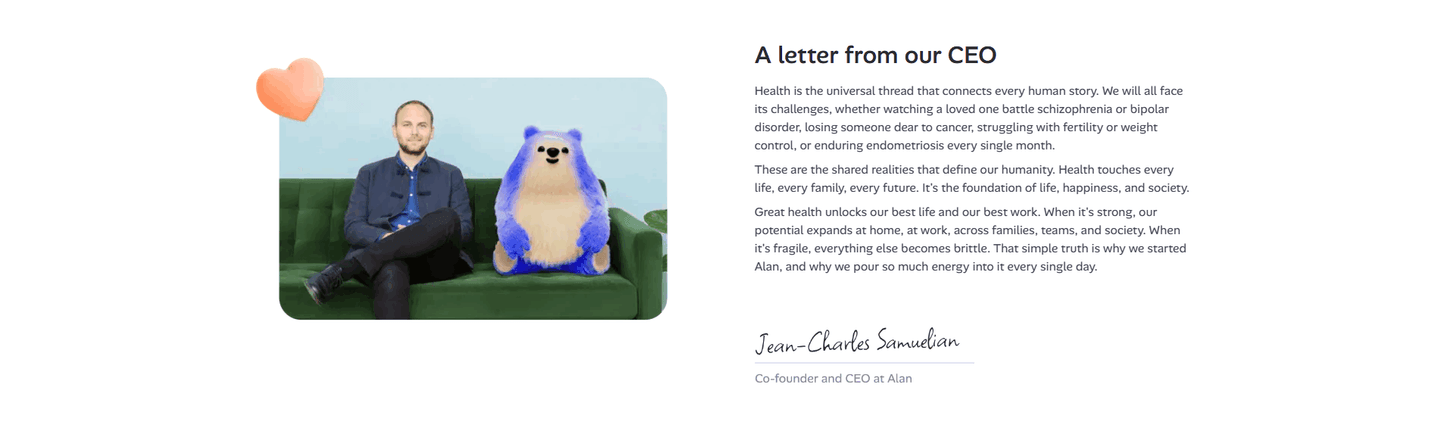
  1. 1A letter from our CEO frames a genuine founder story explaining why Jean-Charles Samuelian started Alan
  2. 2Real photo of the co-founder and CEO, signed by name, makes the mission feel personal and credible
  3. 3Mission framing (great health unlocks our best life and best work) communicates clear company values
  4. 4Handwritten signature and co-founder title add a human, accountable touch to the origin narrative

See how your page compares to the 47.7 insurtech average

Run a section-by-section diagnostic on your insurance page and get prioritized fixes, then see how you stack up against these insurtech website examples.

Design patterns across these insurtech pages

Across 8 insurtech homepage examples, the strongest insurance web design removes ambiguity fast: who it's for, what's covered, and what to do next.

The clearest insurance website examples treat trust as a product feature, using quantified proof, regulatory transparency, and plain-language constraints so visitors don't have to infer credibility from polish alone. Explore our best landing page examples to compare how other industries resolve similar trust friction.

Hero Bestow

78/100

How Bestow captures attention above the fold

Bestow hero section
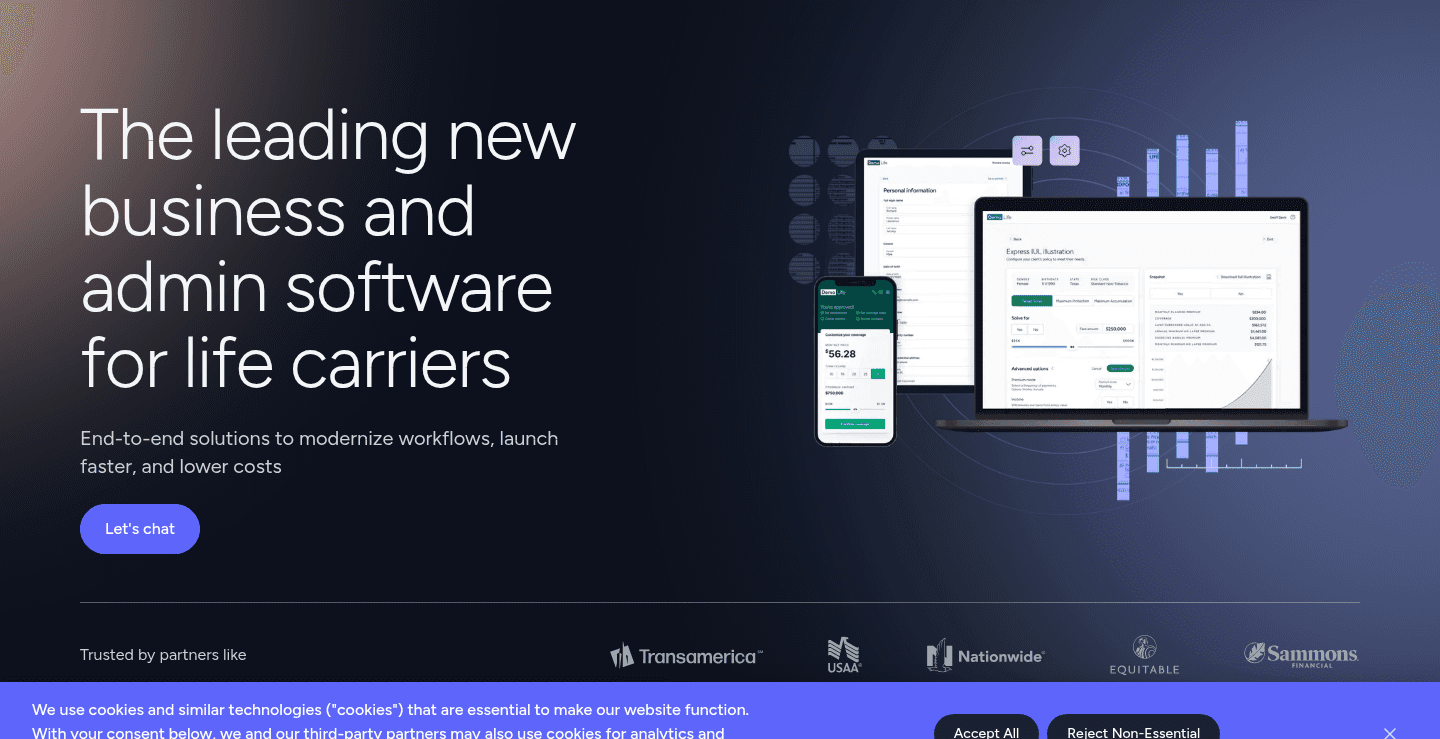
  1. 1Headline names the exact buyer (admin software for life carriers) and stakes a leadership claim (The leading)
  2. 2Subhead promises concrete outcomes (modernize workflows, launch faster, lower costs) not vague benefits
  3. 3Trusted by partners logo row (Transamerica, Nationwide and others) puts recognizable proof above the fold
  4. 4Real dashboard and mobile UI screenshots on the right show the actual product carriers will use

Reviewed design-pattern pick from Bestow’s hero section.

What I love about this section

  • Headline names the exact buyer (admin software for life carriers) and stakes a leadership claim (The leading)
  • Subhead promises concrete outcomes (modernize workflows, launch faster, lower costs) not vague benefits
  • Trusted by partners logo row (Transamerica, Nationwide and others) puts recognizable proof above the fold
  • Real dashboard and mobile UI screenshots on the right show the actual product carriers will use

Value Proposition Alan

67/100

How Alan presents their value

Alan value proposition section
  1. 1Three distinct cards (engagement, access, quality) each anchored by a hard number: 30%+, 260k, 95%
  2. 2Stats tied to concrete outcomes: 260k medical chats each equal to a doctor visit, 95% rated good or excellent
  3. 3Each card pairs its number with a playful 3D illustration (dumbbell, stethoscope, checkmark) for memorability
  4. 4Benefit-specific copy (weekly active users, reviewed daily by our medical team) beats vague wellness claims

Reviewed design-pattern pick from Alan’s value proposition section.

What I love about this section

  • Three distinct cards (engagement, access, quality) each anchored by a hard number: 30%+, 260k, 95%
  • Stats tied to concrete outcomes: 260k medical chats each equal to a doctor visit, 95% rated good or excellent
  • Each card pairs its number with a playful 3D illustration (dumbbell, stethoscope, checkmark) for memorability
  • Benefit-specific copy (weekly active users, reviewed daily by our medical team) beats vague wellness claims

Cta Bestow

40/100

How Bestow drives action without pressure

Bestow cta section
  1. 1Single dominant CTA (Let's connect) with no competing buttons keeps the block focused on one action
  2. 2Goal-framed headline (You've got goals. We've got solutions.) ties the click to the visitor's own outcome
  3. 3Supporting line names the two paths (product demo or a conversation) so visitors know what clicking starts

Reviewed design-pattern pick from Bestow’s cta section.

What I love about this section

  • Single dominant CTA (Let's connect) with no competing buttons keeps the block focused on one action
  • Goal-framed headline (You've got goals. We've got solutions.) ties the click to the visitor's own outcome
  • Supporting line names the two paths (product demo or a conversation) so visitors know what clicking starts

Sections insurance teams underuse (but visitors still look for)

Even with a strong hero, secondary sections often decide whether someone keeps reading, especially in regulated categories where reassurance matters as much as benefits.

In this dataset, Hero tends to outperform at 78 while Testimonial is the most fragile at 17, suggesting many insurance pages invest in messaging but leave gaps in wayfinding and confirmation that slow decisions. See how best fintech websites handle similar trust gaps in adjacent financial services.

About Alan

67/100

How Alan tells their story to build connection

Alan about section
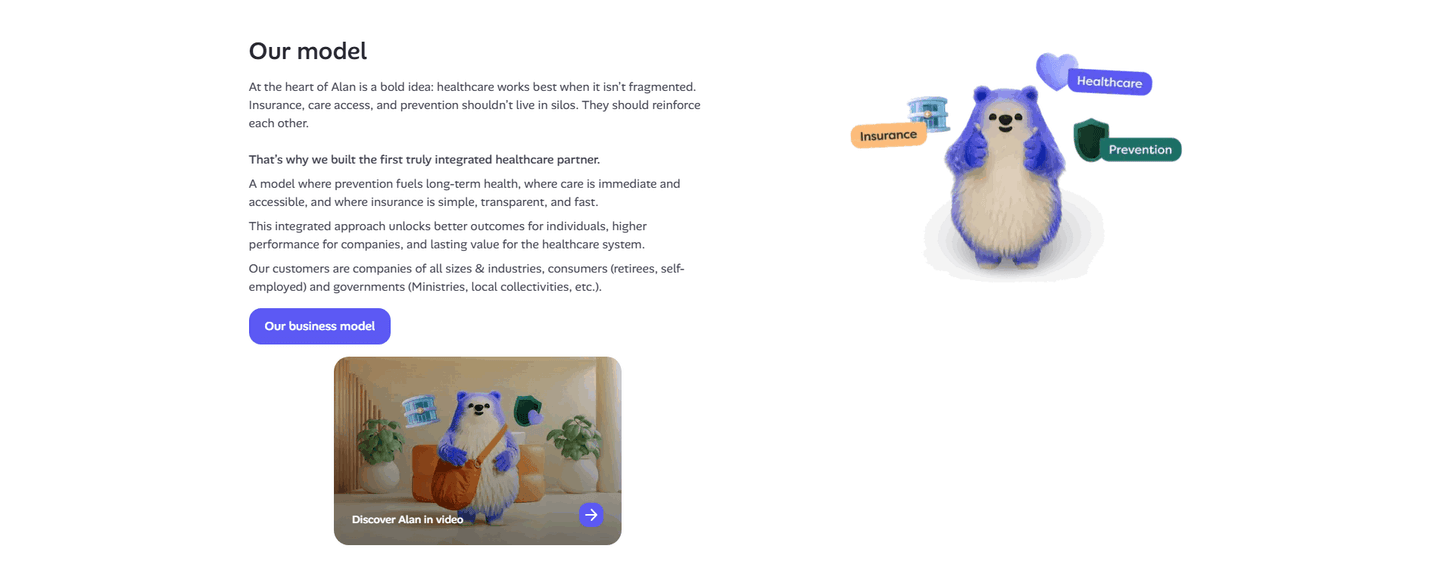
  1. 1Mission statement frames a clear vision: the first truly integrated healthcare partner where insurance, care and prevention reinforce each other
  2. 2Our business model button gives curious visitors a direct path to deeper company detail
  3. 3Discover Alan in video CTA on a thumbnail invites a richer, low-effort way to learn about the company

Reviewed overlooked-section pick from Alan’s about section.

What I love about this section

  • Mission statement frames a clear vision: the first truly integrated healthcare partner where insurance, care and prevention reinforce each other
  • Our business model button gives curious visitors a direct path to deeper company detail
  • Discover Alan in video CTA on a thumbnail invites a richer, low-effort way to learn about the company

Faq Bestow

50/100

How Bestow handles objections through FAQ

Bestow faq section
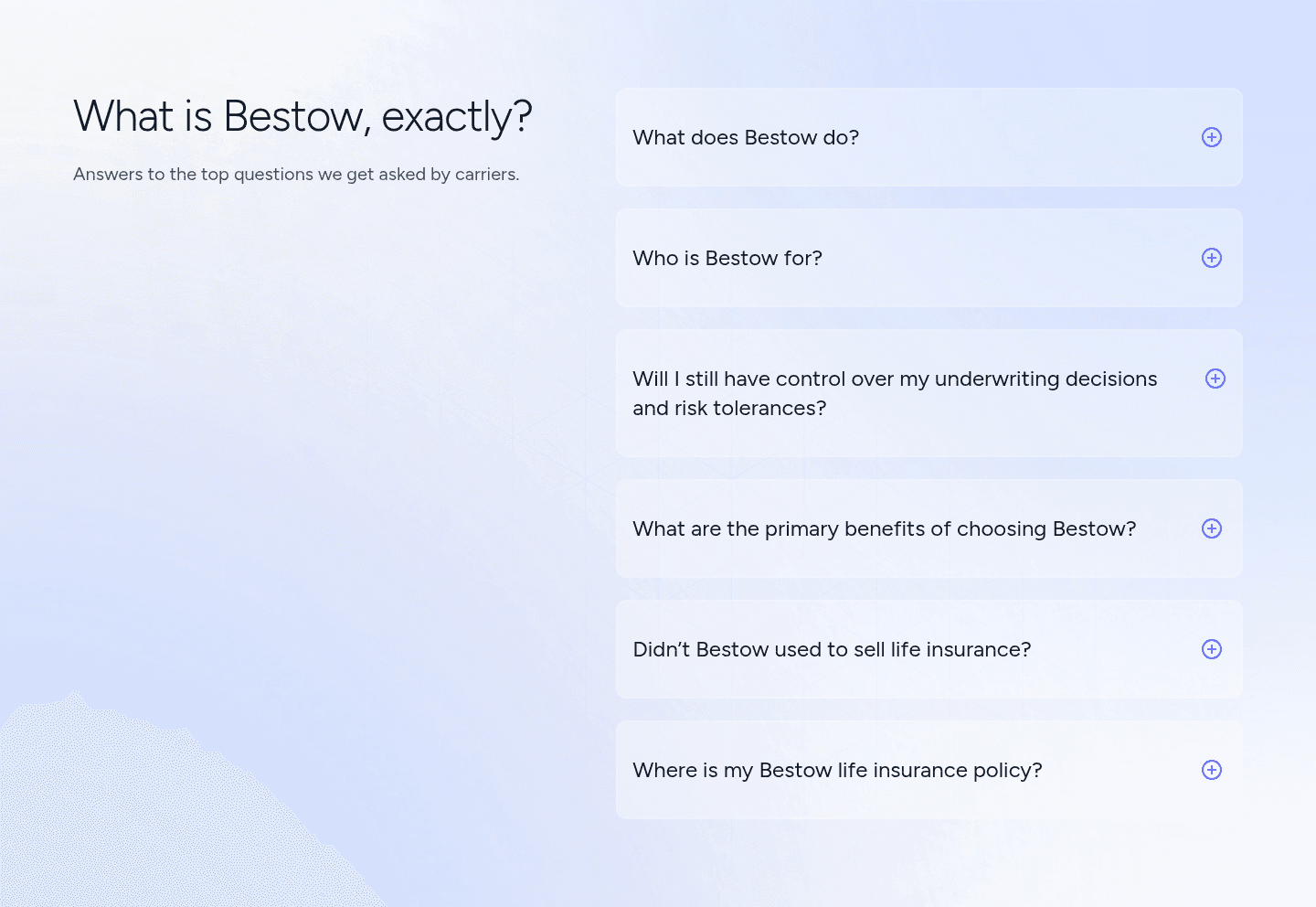
  1. 1Questions tackle real buyer doubts head-on (Will I still have control over my underwriting decisions, Didnt Bestow used to sell life insurance)
  2. 2Accordion format with plus icons keeps six questions scannable without flooding the page
  3. 3Clean question and answer pairs are well-structured for FAQ schema markup and search rich results

Reviewed overlooked-section pick from Bestow’s faq section.

What I love about this section

  • Questions tackle real buyer doubts head-on (Will I still have control over my underwriting decisions, Didnt Bestow used to sell life insurance)
  • Accordion format with plus icons keeps six questions scannable without flooding the page
  • Clean question and answer pairs are well-structured for FAQ schema markup and search rich results

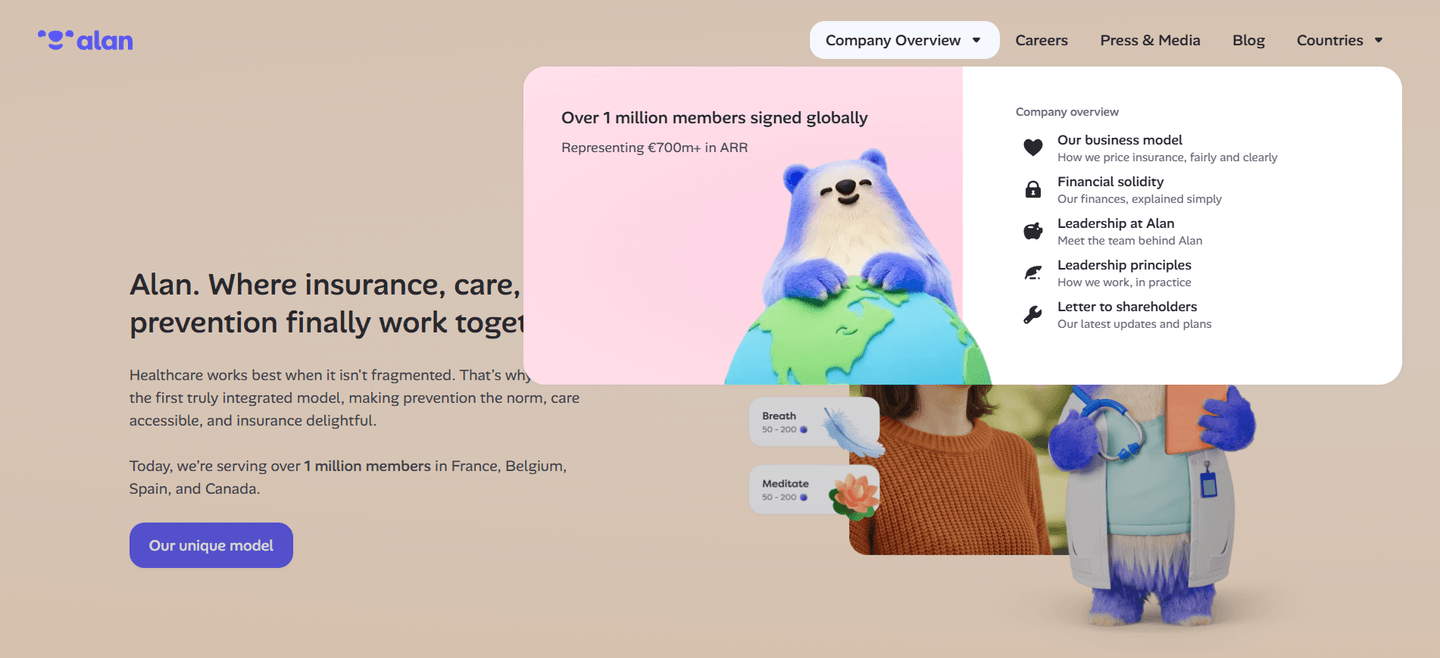
Navbar Alan

43/100

Why this navbar works

Alan navbar section
  1. 1Company Overview mega menu lists categorized topics (Our business model, Financial solidity, Leadership principles) each with a short description
  2. 2Featured card spotlights a proof point (Over 1 million members signed globally, EUR 700m plus in ARR) with brand mascot imagery
  3. 3Countries dropdown acts as a utility selector for a multi-market audience
  4. 4Clean nav focuses on company and content links (Careers, Press and Media, Blog) rather than crowding the bar

Reviewed overlooked-section pick from Alan’s navbar section.

What I love about this section

  • Company Overview mega menu lists categorized topics (Our business model, Financial solidity, Leadership principles) each with a short description
  • Featured card spotlights a proof point (Over 1 million members signed globally, EUR 700m plus in ARR) with brand mascot imagery
  • Countries dropdown acts as a utility selector for a multi-market audience
  • Clean nav focuses on company and content links (Careers, Press and Media, Blog) rather than crowding the bar

If you're refreshing an insurance landing page design, treat these "unsexy" blocks as conversion infrastructure, not filler.

How does your insurance homepage compare?

Five quick questions to see where your page stands against this insurtech benchmark. For a full section-by-section audit, try our landing page analyzer.

Interactive quiz

What would your insurance homepage score?

Question 1 of 5
0%

Does your insurance page show a trust signal before the first scroll?

Customer count, carrier logos, regulatory badges, or transparent pricing.

Gabriel Amzallag

Reviewed by

Gabriel Amzallag , Founder, Web Anatomy

5 years CRO + SEO at Qonto (2021–2025). After advising 15+ SaaS on their websites (Payfit, Pigment…), the same patterns kept breaking, so I decided to build the source of truth on what works on the web: the intelligence layer every tool, builder, and team uses to ship sites that perform.

See how your page compares to the 47.7 insurtech average

Run a section-by-section diagnostic on your insurance page and get prioritized fixes, then see how you stack up against these insurtech website examples.

Analyze your insurance pageFree. Takes 2 minutes.

Explore other industries

See how conversion patterns differ across verticals. Each page scores real homepages on the same framework.

See all industries
Benchmark-backed answers for insurtech website design

FAQ: Best Insurance Websites (InsurTech Benchmarks)

Quick answers to common questions about what makes the best insurance websites convert, based on section-level benchmark data from this insurtech review.

What makes insurance websites harder to convert than other industries?

[01]

Insurance is a high-stakes, low-frequency purchase. Buyers arrive skeptical and refuse to share personal data until they feel safe. Across 8 homepages reviewed in June 2026, the pages that convert, Alan, Hippo, Ladder, and Policygenius, treat every section as a trust checkpoint and remove a concrete friction in the first pitch: "no medical exam," "quote in 60 seconds," or "compare carriers side by side."

Should an insurance homepage lead with price or trust?

[02]

Trust first, price second. Ladder opens with "term life that fits your life" before showing any premium; Alan leads with its prevention-first category claim; Policygenius lets buyers compare carriers before any one pitches them. Across 8 homepages reviewed, the pages that delayed pricing scored higher on value-proposition clarity. The buyer had a reason to care about the number by the time they saw it.

What is the biggest messaging mistake on insurance homepages?

[03]

Generic "protect what matters" headlines with no specific benefit and no low-friction next step. The average page scored 47.7 across 8 homepages reviewed. Top performers replace abstract promises with verifiable proof: Ladder's no-medical-exam promise, Hippo's smart-home-first prevention, and Alan's quantified usage, 30%+ weekly active users, 260k medical chats, 95% quality rating. Visitors need something real to evaluate in the first ten seconds.

How do you find the best insurance websites to review before a redesign?

[04]

Compare real pages side by side, section by section, not as full-page screenshots. This review scores 8 insurance homepages in June 2026 against 60+ criteria. The strongest performers are Alan (health insurance), Hippo (home), Ladder (life), and Policygenius (carrier comparison). Benchmark each against the trust band and how-it-works sections first, since those load-bearing blocks decide whether a risk-averse buyer keeps reading.

Which insurance homepage sections should you fix first?

[05]

Fix the trust band and the how-it-works section before touching the hero. Insurance buyers are risk-averse; they scroll for proof before they read headlines. A trust row with carrier logos, regulator references, and a coverage amount earns the next scroll. A three-step how-it-works section with concrete details ("bind a policy in 4 minutes", "file a claim via SMS") converts more than any headline rewrite. Hero and pricing are polish. The mid-page sections are the load-bearing wall.

What is the best website for insurance?

[06]

There is no single best, it depends on your product line. For digital-first life insurance, Ladder is the template (no medical exam, instant decisions). For home, Hippo leads with prevention and smart-home technology. For health, Alan quantifies product usage to make a category-defining claim. For carrier comparison, Policygenius is the model. All 8 homepages in this June 2026 review are scored on the same rubric.

Where can I find great insurtech website design inspiration?

[07]

Study insurance homepages section by section, not as full-page moodboards. Browse best landing page examples for the full gallery, then drill into hero section examples, trust section examples, and pricing section examples to see how Alan, Hippo, and Ladder differ at each funnel stage.